EV Charger Installation Calgary
CLICK ON THE MAGNIFYING GLASS 🔎 BELOW FOR BLOGS BY SUBJECT MATTER. CLICK ON THE ❌ ICON TO CLOSE.
ELECTRIC VEHICLE and Hybrid CHARGERS
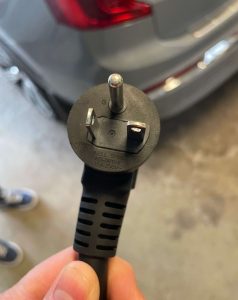
Caption: The photo above shows the 240 volt/20 amp plug end of a 2026 VOLVO XC90 Hybrid in Calgary which uses a 240 volt 20 amp receptacle and breaker to charge overnight. From factory, they come equipped with a plug end that connects to a regular 15 amp 120 volt receptacle/outlet which requires 12-14 hours to charge.
you can upgrade to a 240 volt – 20 amp receptacle that works with the plug end in the photo above and it takes 5 hours to charge instead of 12 – 14 hours. shoot us a message or email and we can walk you through it based on your attached or detached garage construction.
powering up: A Homeowner’s guide to EV Chargers
The first electric vehicle goes as far back as an electrified carraige in 1832, they’ve been around much longer than we thought, almost 200 years! By 2030, the Canadian government mandates that 60% of all new light-duty vehicles sold must be zero-emission vehicles (ZEVs). This target is part of a phased approach to reach 100% of new sales by 2035. While 2025 sales data shows a recent slowdown in momentum, official policy aims for rapidly increasing market share from the 20% target in 2026.
Edison Electric Institute predicts that by the year 2030, about one-third of vehicles in the United States will be battery-powered. While the environmental benefits and federal rebates make buying an electric vehicle (EV) incredibly attractive, figuring out how to keep it powered can feel a little overwhelming.
Charging your car at home is the most affordable and convenient option available. If you happen to have grid-tied solar panels on your roof, it’s an absolute no-brainer; you might even be able to power your car for free. Here is everything you need to know about setting up your home charging station.
Level Up: Understanding Charger Types
Electric vehicle supply equipment (EVSE)—more commonly known as chargers—are categorized by the amount of amperage they can deliver. Higher amperage means a faster charge.
| Charger Type | Power Supply | Miles of Range Per Hour | Best For… |
| Level 1 | 120v standard outlet |
2 to 5 miles |
Occasional use, though typically too slow for a daily commuter. |
| Level 2 | 240v household circuit |
10 to 20 miles |
Most homeowners; it provides the best overnight charge. |
| Level 3 | 480v commercial power |
180 to 240 miles |
Public charging stations; their power requirements are too massive for residential areas. |
For home use, a Level 2 charger makes the most sense. While Level 1 chargers might suffice if you drive less than 40 miles a day, a Level 2 charger allows you to wake up to a fully charged battery every morning.
Connector Confusion Cleared Up
Currently in North America, you will encounter two main connector types: the NACS (used by Tesla) and the J1772 plug. In 2022, Tesla allowed other manufacturers to use the NACS connector, and starting in 2025, multiple auto companies will equip their EVs with the NACS port straight from the factory. Don’t worry if your car and charger don’t perfectly match; adapters are widely available and typically cost between $70 and $170.
Shopping for a Level 2 Charger: Top Features & Models
When shopping for a Level 2 charger, always verify that the unit has UL certification and a warranty of at least three years. The cable should be at least 20 feet long so you aren’t struggling to reach your car, and look for a weatherproof housing if it will be mounted outside. Level 2 chargers generally cost between $300 and $700, though specialized models can be more expensive.
Here are some standout options and features currently on the market:
-
Smart Remote Monitoring: Models like the ChargePoint Home Flex ($550) utilize smartphone apps to keep you informed of your battery level and let you schedule charging during off-peak energy hours.
-
Extreme Outdoor Durability: If your charger lives outside, the Grizzl-E Avalanche Edition ($350) is designed specifically to withstand harsh weather conditions.
-
Hassle-Free Cord Management: EV cables are heavy and can be frustrating to put away. The Enphase HCS series (Starting at $730) solves this by looping the cord over a built-in hose rack design.
-
Sleek Handling: The Legrande L2EVSE48AC ($650) features a separate side holster so you can hang the plug closer to your car, preventing the cable from dragging on the floor.
-
Two-Car Homes: Have two EVs? The Grizzl-E Duo ($800) uses dual 24-foot cables and load-sharing technology to charge two vehicles at the exact same time.
-
Garage Aesthetics: The Tesla Wall Connector ($475) offers four different colors of faceplates so you can match the charger to your car or your garage’s decor.
-
Maximum Output: Massive trucks require massive power. The Ford Charge Station Pro ($1310) is an 80-amp hardwired beast that can bring a giant battery, like the F-150 Lightning’s, to 100% in about 8 hours.
Installation Need-to-Knows
Whether you choose a hardwired charger (which offers faster charging but is more expensive to install) or a plug-in model (which is cheaper and easier to move for renters), you will need a 240v electrical circuit.
Hire a Pro: Installation averages between $400 and $1700, and a licensed electrician must pull a permit to ensure the work is up to code. (Bonus: Look into a federal tax credit that can cover up to 30% of your installation cost!).
Clearances: The National Electrical Code requires chargers to be mounted at least 18 inches off the floor indoors (24 inches if outdoors) and have at least 12 inches of clearance on both sides.
Plug-In Warnings: If you opt for a plug-in model, you’ll need a heavy-duty, commercial-grade NEMA 14-50 or 6-50 receptacle. These heavy-duty plugs are not meant to be repeatedly unplugged, as doing so can loosen the internal connections and create a serious fire hazard.
In some cases like the volvo xc90 hybrid, you have a 240 volt 20 amp plug-in like the one in the site photo below. the customer wanted to be able to have the convenience of being able to plug-in as they were pulling into the garage or backing in depending on what kind of task they were completing while parking their volvo xc90. so, we installed 2 – 20 amp 240 volt receptacles, one at the front of the garage near the overhead door and one at the rear near the man door.
What’s Next? Wireless and Two-Way Power
The future of EV charging is incredibly exciting! We are moving toward inductive charging, where a wireless ground pad creates a magnetic field to charge your car just by parking over it.
We are also entering the era of bidirectional charging. New technology allows EVs to transfer power back out of their batteries. Trucks like the Ford F-150 Lightning can currently power job-site tools, and when paired with a home integration system, can even power an average house during a blackout for up to three days. Eventually, your EV could even sell power back to the grid during periods of high electrical demand, acting just like a solar net-metering system.
YYC ELECTRICIAN
We at YYC ELECTRICIAN love the winter scene here in this beautiful city. Admittedly Calgary weather can be tough when the pot lights aren’t working, the dimmer switches aren’t dimming and you need emergency electrical services that can tackle an electric hot water heater, infloor radiant heating and everything else that keeps your day to day operating smoothly. We can get your heating systems back up and running as well as the pot lights regardless of whether it’s during standard operating hours or you’re searching online for an emergency electrician near me kind of thing. We service electric radiant heat, hydronic heating controls and furnace heating systems. If there are cables and wires than we can tackle it.