Electrical Panels
CLICK ON THE MAGNIFYING GLASS 🔎 BELOW FOR BLOGS BY SUBJECT MATTER. CLICK ON THE ❌ ICON TO CLOSE.
Electrical Panel Anatomy
A Guide to Your Home’s Electrical Panel
Ever looked at that mysterious metal box tucked away in your basement or garage and wondered what all those switches actually do? You’re not alone.
Think of your home’s electrical panel as a central train station for electricity. Its job is simple: take the massive stream of power coming from the utility company on the street and safely route it into smaller pathways (called circuits) that feed your lights, TV, fridge, and outlets. Most importantly, it acts as your home’s primary security system against electrical fires and shocks.
Let’s break down how it works—no electrician degree required!
From Fuse Boxes to Modern Panels
If you live in an older home, you might remember screw-in glass fuses. Before the 1960s, these fuse boxes were the standard. Whenever a circuit overloaded, the fuse blew, and you had to physically unscrew it and screw in a new one.
By the mid-1960s, modern circuit breaker panels took over. Instead of replacing a fuse, you just flip a switch to reset power.
Fun Fact for Homeowners: Just because your panel is old doesn’t mean you automatically need to replace it. As long as an older panel met safety codes when installed, was installed properly, and has been kept in good condition, it can still safely power your home today.
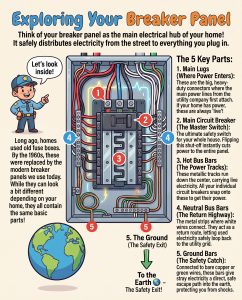
The 5 Main Parts Inside Your Panel
If you pop open the panel door, you’ll see five key components working together:
1.) Main Lugs (The Front Door): These heavy-duty metal connectors attach directly to the main power lines coming from the street. As long as your power is on, these lugs are live with electricity.
2.) Main Circuit Breaker (The Master Switch): This is the ultimate “Off” switch for your whole house. Flipping this shuts down power to every single breaker and wire in the panel at once.
3.) Hot Bus Bars (The Power Tracks): These metal strips run down the center of the panel, carrying live electricity. Your individual circuit breakers clip directly onto these tracks to pull power.
4.) Neutral Bus Bars (The Return Highway): Electricity works in a loop—it goes out, powers your device, and must return. White “neutral” wires collect used electricity from your devices and send it back out to the power grid through these bars.
5.) Ground Bars (The Emergency Exit): Bare copper or green wires connect to these metal bars. If electricity ever strays from its normal path, these bars give it a safe route straight into the ground instead of shocking you.
How Power Flows & Keeps You Safe
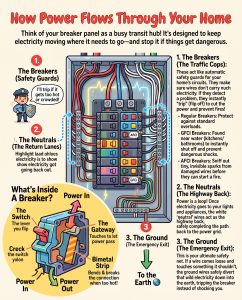
Once electricity enters the panel, special switches called breakers control the flow. Think of them as smart safety guards that jump into action if something goes wrong:
1. The Breakers (Safety Guards)
-
Standard Breakers: Protect against overloads (running too many appliances at once, causing wires to heat up) and short circuits (when hot wires touch neutral wires). When a problem occurs, internal mechanisms instantly snap the switch off.
-
GFCI Breakers (Shock Protection): Required in areas near water like kitchens and bathrooms. They measure the electricity going out and coming back; if even a tiny bit leaks out, they trip instantly to prevent severe shocks.
-
AFCI Breakers (Fire Protection): Required in most living areas, these watch out for dangerous sparking from damaged, frayed, or chewed wires inside walls—cutting power before a spark can start a fire.
2. Completing the Circuit
After electricity drops off its energy at your lamp or appliance, it travels back through white neutral wires to the neutral bar, completing the circuit loop back to the utility company.
3. Grounding for Peace of Mind
If a loose wire inside a toaster or lamp touches its metal frame, touching that device could give you a dangerous shock. The ground wire routes that stray power right back to the panel’s ground bar and safely down into the Earth, tripping the breaker instantly and keeping your home safe
YYC ELECTRICIAN
We at YYC ELECTRICIAN love the winter scene here in this beautiful city. Admittedly Calgary weather can be tough when the pot lights aren’t working, the dimmer switches aren’t dimming and you need emergency electrical services that can tackle an electric hot water heater, infloor radiant heating and everything else that keeps your day to day operating smoothly. We can get your heating systems back up and running as well as the pot lights regardless of whether it’s during standard operating hours or you’re searching online for an emergency electrician near me kind of thing. We service electric radiant heat, hydronic heating controls and furnace heating systems. If there are cables and wires than we can tackle it.