Your Home’s Electrical Panel, Explained
That grey metal box in your basement or garage is the most important safety device in your home. Here’s what’s inside it, how it keeps you safe, and the signs it’s time for a Calgary electrician to take a look. No electrician’s licence required.
CLICK ON THE MAGNIFYING GLASS 🔎 TO OPEN EACH TOPIC. CLICK ON THE ❌ ICON TO CLOSE.
Electrical Panel Anatomy
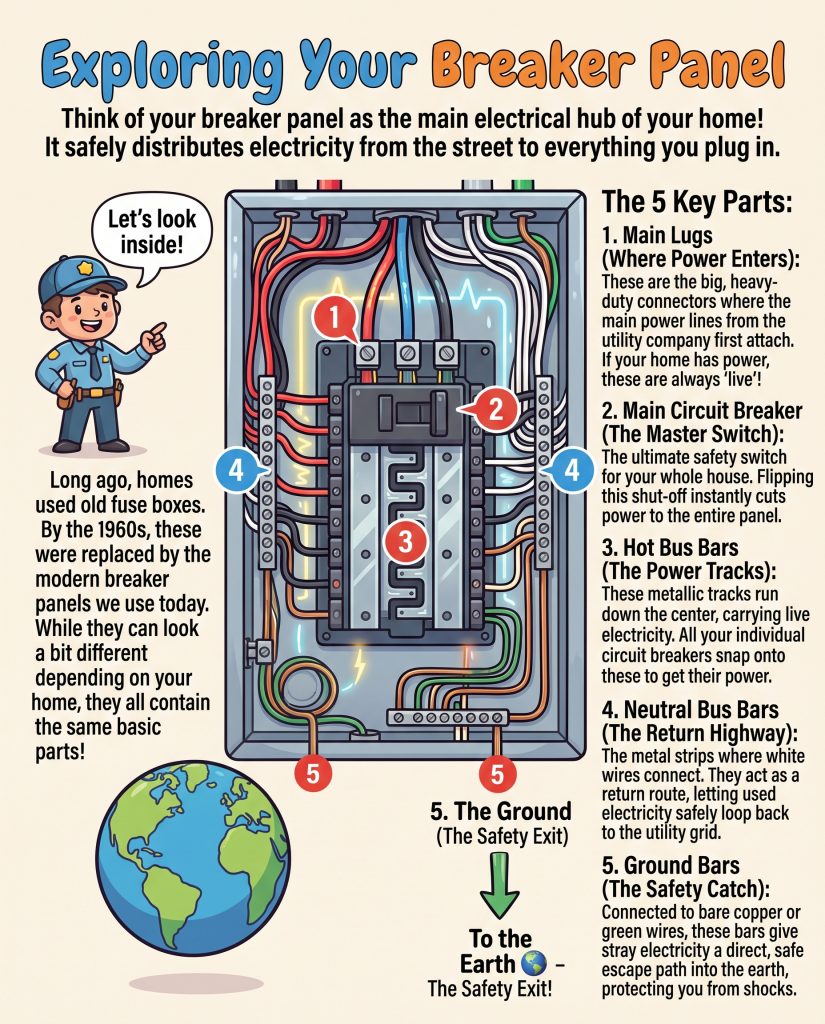
Think of your electrical panel as the central train station for electricity. Power arrives from the utility line on the street, and the panel safely splits it into smaller routes called circuits that feed your lights, outlets, furnace and appliances. Just as importantly, it’s your home’s first line of defence against electrical fires and shocks.
The 5 main parts inside your panel
- Main lugs (the front door): Heavy-duty connectors where the utility’s service wires land. They stay live whenever your power is on, even with the main breaker off.
- Main breaker (the master switch): One switch that shuts off power to every circuit in the house at once.
- Hot bus bars (the power tracks): Metal strips down the centre of the panel. Each breaker clips onto them to draw power.
- Neutral bar (the return highway): Electricity travels in a loop. White neutral wires carry it back from your devices to this bar.
- Ground bar (the emergency exit): Bare copper and green wires connect here, giving stray current a safe path to earth instead of through you.
How Power Flows & Keeps You Safe
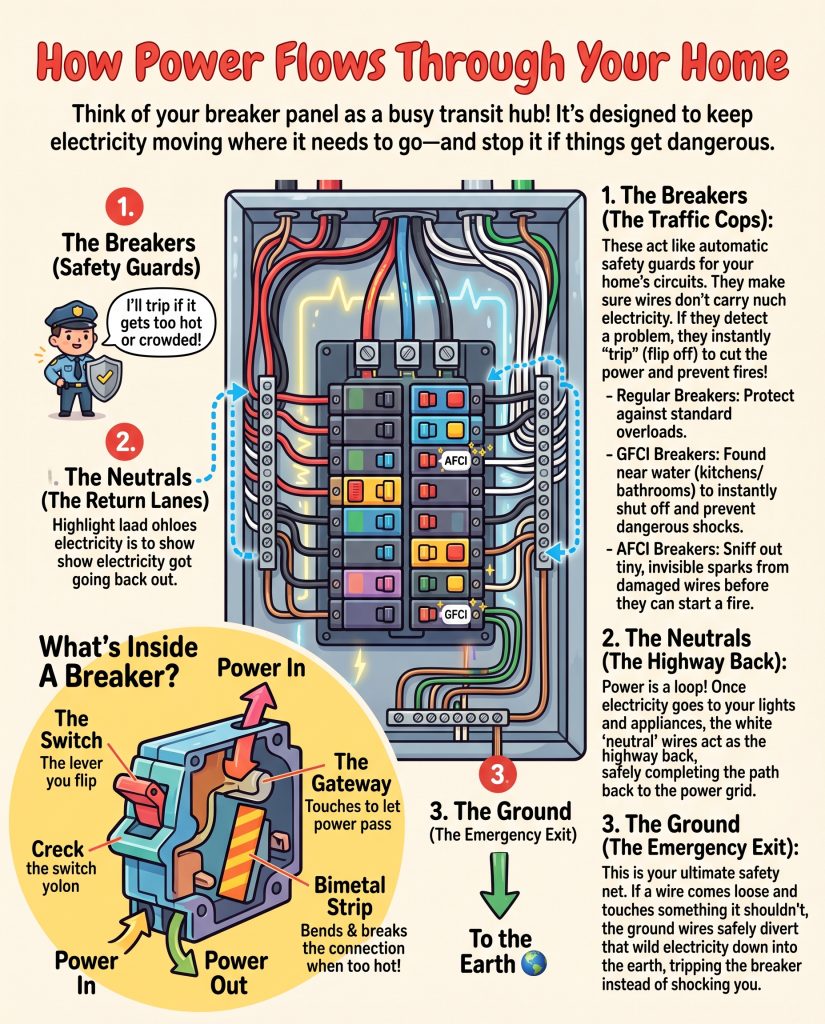
Once power enters the panel, breakers act like safety guards that jump in the instant something goes wrong.
Three kinds of breakers
- Standard breakers: Trip on overloads (too many appliances heating up a wire) and short circuits (a hot wire touching neutral or ground).
- GFCI protection (shock protection): Used near water: bathrooms, kitchens, outdoors and garages. It compares current going out with current coming back and trips if even a tiny amount leaks away, for example through a person.
- AFCI breakers (fire protection): Required on most living-space circuits in newer homes. They detect dangerous arcing from damaged, loose or chewed wires inside walls and cut power before a spark can start a fire.
Completing the loop
After electricity does its work in your lamp or fridge, it returns on the white neutral wire to the neutral bar, completing the circuit.
Grounding for peace of mind
If a loose wire inside a toaster touches its metal case, the case could become live. The ground wire sends that stray current back to the panel’s ground bar and into the earth, tripping the breaker right away so nobody gets shocked.
From Fuse Boxes to Modern Panels
Older Calgary homes may still have screw-in glass fuses. Until the 1960s, fuse boxes were standard: when a circuit overloaded, the fuse blew and had to be physically replaced.
Modern breaker panels took over from the mid-1960s. Instead of swapping a fuse, you simply reset a switch.
Panels that deserve a closer look
- Fuse panels, especially with oversized fuses installed to stop “nuisance” blowing.
- Federal Pacific (Stab-Lok) and Zinsco panels, brands widely reported to have breakers that may fail to trip.
- 60 or 100 amp services in homes adding EV chargers, heat pumps, hot tubs, suites or electric heating.
Signs It's Time for an Upgrade
- Breakers trip often, or the same breaker keeps tripping.
- Lights dim or flicker when the furnace, A/C or microwave starts.
- The panel cover feels warm, smells hot, or you hear buzzing or crackling.
- Rust, water stains or scorch marks on or inside the panel.
- No empty spaces left, or lots of “double-tapped” and tandem breakers.
- You’re planning an EV charger, heat pump, basement suite, hot tub or major renovation.
What an upgrade typically involves
- A load calculation to size the service (often 100A to 200A).
- Permit application and booking the utility disconnect.
- Replacing the panel, main breaker and any undersized service wiring.
- Adding AFCI/GFCI protection where required and labelling every circuit clearly.
- City inspection and power restored, usually the same day.
Panel acting up? We’ll take a look.
Breakers tripping, buzzing, warm covers or planning an EV charger or heat pump? YYC ELECTRICIAN handles panel inspections, upgrades and permits across Calgary.
What Calgary Customers Are Saying