Hydronic Heating
CLICK ON THE MAGNIFYING GLASS 🔎 BELOW FOR BLOGS BY SUBJECT MATTER. CLICK ON THE ❌ ICON TO CLOSE.
Warm Toes, Happy Life: A Beginner’s Guide to Radiant Floor Heating
If you’ve ever woken up on a freezing winter morning and dreaded the moment your feet hit the floor, you’ve probably dreamt of radiant heating.
Unlike standard furnaces that blast dusty, noisy air through vents, radiant floor systems are the silent superheroes of home comfort. But here’s the thing: those cool-looking tubes snaking under the floorboards are only half the story. To get that “perfect temperature” feeling, you need a solid team of equipment working behind the scenes.
Here is the “behind-the-curtain” look at how your floors actually get warm.
The Anatomy of a Warm Floor
Think of your heating system like the circulatory system in your body. It’s a loop that needs a few key players to keep things moving:
-
The Heat Source: This is the “heart” of the system. It could be a classic boiler or a modern heat pump. Its only job? Get that water moving and get it hot.
-
The Circulator: This is a specialized pump that pushes the water through your pipes.
-
The “Blender” (Mixing Valve): Here’s a pro tip—your boiler makes water hot, but your floors only need to be warm. A mixing valve blends the hot water with cooler water returning from the floor so you don’t cook your toes.
-
The Manifold: Think of this as a traffic cop. It sits at a station and decides exactly how much warm water goes to which room.
Choosing Your Boiler: Traditional vs. High-Tech
When it’s time to pick the machine that actually heats the water, you usually have two main paths:
1. The Old Faithful (Conventional Boilers)
Most of us are used to the big cast-iron or steel boilers. They are the tanks of the heating world.
-
The Perk: They are incredibly durable (some last 30+ years!) and can handle both your floor heating and high-heat radiators at the same time.
-
The Trade-off: They are heavy and take a little longer to warm up.
2. The Speedster (Low-Mass Boilers)
These use copper tubing with “fins” to heat water almost instantly.
-
The Perk: They are much smaller and lighter than the old-school versions.
-
The Trade-off: While they’re faster, they weren’t necessarily more efficient than a well-maintained traditional boiler. But, in recent years some manufacturers have designed and built wall mounted condensing boilers that have an AFUE (Annual Fuel Utilization Efficiency) of 92-95% and in some cases reaching upwards of 98.5%. In short, boiler technology has really come along way!
The Bottom Line
Most modern boilers—whether gas or oil—run at about 80% to 85% efficiency. While it’s tempting to just shop for the lowest price tag, remember that these systems are a long-term relationship.
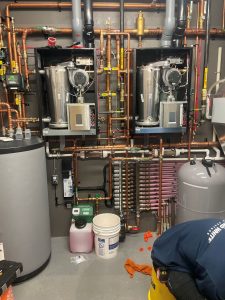
We service, maintain and install all makes and models. The photo’s below were taken from a job we recently completed for a customer who had a full mechanical retro-fit which included two air handling units, two wall mounted condensing boilers, 5 circulating pumps and 14 zone valves for 6 basement infloor hydronic heating system zones.
The two wall mounted condensing boilers depicted in the photo below are of the IBC brand manufactured in Burnaby, British Columbia. There are several models manufactured by local companies in Calgary and Alberta as well. They make high quality units that we’ve grown to trust with little to no call backs. Reach out to us if you’re interested in talking about the locally made heating systems, we love them ourselves and have installed them in our own homes.
Pro Tip: A good boiler can last three decades, but only if someone knows how to fix and maintain it! Maintenance is key, the cost of maintenance is far less avergaed over the long term than paying for a “no heat” call, having a boiler repaired in Calgary unexpecteldy in the dead of winter when you’re worried your pipes are going to freeze, expand followed by rupturing. Especially, when you’re on vacation.
Before you buy, make sure there is a local pro in your area who knows that specific brand inside and out. Radiant heat is an investment in your home’s “cozy factor.”
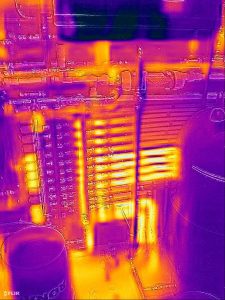
The images above and below are of a complex 6 Basement zones, 2 Air handling unit, 2 wall mounted boiler, 1 Indirect hot water tank, 6 pumps and 14 actuators combined to heat the homes basement concrete infloor radiant heat, forced air through the two air handling units, wall mounted radiators and the domestic hot water supplying all the taps.
One of our google reviews explains this much regarding their large home out in Bragg Creek and it was a challenge logistically but we were up for it. The kind of thing we like to geek out on! The two images show the system from two lenses, the lense above to the nake eye and the lense below through a thermographic imaging camera; FLIR. The FLIR image shows us ramping up the system after commissioning and repairing the system after several checks and balances.
YYC ELECTRICIAN
We at YYC ELECTRICIAN love the winter scene here in this beautiful city. Admittedly Calgary weather can be tough when the pot lights aren’t working, the dimmer switches aren’t dimming and you need emergency electrical services that can tackle an electric hot water heater, infloor radiant heating and everything else that keeps your day to day operating smoothly. We can get your heating systems back up and running as well as the pot lights regardless of whether it’s during standard operating hours or you’re searching online for an emergency electrician near me kind of thing. We service electric radiant heat, hydronic heating controls and furnace heating systems. If there are cables and wires than we can tackle it.