HVAC & Furnaces
CLICK ON THE MAGNIFYING GLASS 🔎 BELOW FOR BLOGS BY SUBJECT MATTER. CLICK ON THE ❌ ICON TO CLOSE.
FURNACES FOR BEGINNERS...
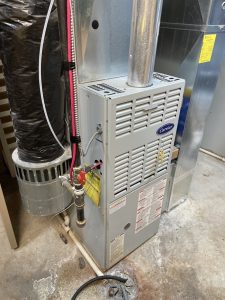
Getting to know your furnace and forced air systems:
If you live in Calgary, there is a very good chance your home is heated by a forced-air furnace. These systems are popular because they are inexpensive, readily available, and easy for local contractors to service. They work by burning fuel—most commonly natural gas, though propane, oil, and firewood are also options—and delivering that heated air through a network of ducts to registers throughout your home.
Understanding Furnace Efficiency
When shopping for a furnace, you will see a rating called AFUE (Annual Fuel-Utilization Efficiency). This percentage simply tells you how much of the fuel going into the furnace is successfully converted into usable heat for your home. Today, the federal government mandates a minimum efficiency of 80%.
Furnace Category AFUE Rating Key Features
Medium-Efficiency 80% to 82%
Flue gases remain hot enough to prevent moisture condensation. These rely on a natural draft to send exhaust gases up a chimney.
High-Efficiency (Condensing) 90% to 98%
These extract so much heat that flue gases cool and condense into a liquid. They require a drain for the condensate but can safely vent exhaust through inexpensive PVC pipe out a wall.
Why isn’t there anything in between? You will not find furnaces rated between 83% and 89% because they would cause sporadic condensation. This middle ground leads to expensive corrosion problems; it is better to either avoid condensation entirely or handle it dependably.
Choosing Your Furnace Type
Furnaces generally come in three main varieties based on how they deliver heat:
Single-Stage: These are the simplest models, meaning they only have one setting: fully on or fully off. They deliver their maximum heat output regardless of how cold it actually is outside.
Two-Stage: These can run at two different output levels. Most of the time, they operate at a lower capacity—usually around 65%—to save energy, only kicking into high gear on the coldest days of the year.
Modulating: These are the smoothest operators, using an automatic valve to continuously adjust the amount of fuel delivered based on exact heating demands. This avoids the stop-and-go jerkiness that you get with a single-stage unit.
Ductwork Dos and Don’ts
A furnace is only as good as the ducts connected to it. Here is how to keep your system breathing easily and efficiently:
Stick to rigid ducts: Rigid galvanized ducts are highly preferred. Flexible ductwork is hard to keep straight and has corrugations that cause air turbulence, reducing airflow.
Never use wall framing: Using stud bays or framing cavities to move air allows it to leak through gaps and is actually a code violation.
Seal everything: Use mastic or foil tape on all duct and plenum seams to prevent substantial energy loss.
Plan for return air: Every conditioned room needs a path back to the furnace, either through its own return-air grille or a jumper duct connecting it to a room that has one. Avoid relying on a single, central return grille, which can cause closed-off bedrooms to become pressurized.
Keep it central: Locate the furnace in the center of your basement or home to keep duct runs as short as possible. Both the furnace and ducts should be inside your conditioned living space, not in a vented attic or crawlspace.
Important Tips on Sizing and Thermostats
Bigger isn’t always better. Many contractors intentionally oversize furnaces to avoid callbacks or to allow for future home expansions. However, an oversized furnace costs more up front and runs less efficiently. To get the perfect fit, insist that your contractor performs a “Manual J” calculation, which accurately determines your home’s exact heat loss by looking at its shape, insulation levels, and airtightness.
Careful with the thermostat! If you have a high-efficiency condensing furnace, be warned: setting your thermostat too low when you go on vacation could void your warranty. For example, Carrier warns that keeping the return-air temperature below 15.6 °C (60°F) continuously (or 12.8 °C [55°F] intermittently) can cause corrosive condensation to form in the primary heat exchanger, damaging the unit.
Understanding and monitoring Calgary weather Patterns allows you to maximize the time at which you turn on either your heating system in the winter or cooling system in the summer. Whether Calgary experiences humid July’s from lots of rain fall, to frigid and dry winters that leave your skin crackiing.
Your air conditioner will ramp up to help keep the house cool throughout a hot summer day. In the winter your furnace will ramp up with natural gas burners and in some cases coupled with a duct mounted humidifier, work to keep your home warm and less dry on a cold winter day.
The best way to optimize home comfort is with a smart home thermostat that monitors the weather in relation to the internal temperature of the house. The smart thermostats will make automatic adjustments based on what temperature/humidity range makes you feel comfortable.
Last but not least, it doesn’t take much to maintain your new furnace. Especially, because it’s a fresh start. So, take this opportunity to swap out filters regularly and have it inspected. Neglecting a furnace and not maintaining it always comes at a higher price when you have to make that emergency furnace repair in calgary on a weekend, when you’re out of town and in the darkest months of the winter. Last thing you need are pipes freezing because there’s no heat
YYC ELECTRICIAN
We at YYC ELECTRICIAN love the winter scene here in this beautiful city. Admittedly Calgary weather can be tough when the pot lights aren’t working, the dimmer switches aren’t dimming and you need emergency electrical services that can tackle an electric hot water heater, infloor radiant heating and everything else that keeps your day to day operating smoothly. We can get your heating systems back up and running as well as the pot lights regardless of whether it’s during standard operating hours or you’re searching online for an emergency electrician near me kind of thing. We service electric radiant heat, hydronic heating controls and furnace heating systems. If there are cables and wires than we can tackle it.